Xiong Announces Express Lane Health Enrollment for Eligible Michigan Kids
“Express Lane Enrollment” legislation would enact a streamlined health care enrollment process for eligible children and young adults under 21
LANSING, Mich., April 23, 2026 — State Rep. Mai Xiong (D-Warren) recently introduced legislation that would enact a streamlined enrollment process for children and young adults under 21 who may be eligible for Medicaid and health care programs administered through the Michigan Department of Health and Human Services (MDHHS). Xiong’s House Bill 5884 provides a common sense fix: Express Lane Eligibility (ELE), already authorized under federal law, which allows DHHS to use existing Supplemental Nutrition Assistance Program (SNAP) and Temporary Assistance for Needy Families (TANF) data to streamline Medicaid enrollment for kids and young adults.
Xiong, Cherry Introduce Medicaid Buy-In Program to Make Healthcare More Affordable for Michigan Workers
LANSING, Mich., Aug. 26, 2026 — State Rep. Mai Xiong (D-Warren) and state Sen. John Cherry (D-Flint) introduced legislation this week to create a Medicaid buy-in program to make affordable healthcare available for more Michiganders.House Bill 6274and its companion, Senate Bill 1152, would enable Michiganders earning between 138-200% of the federal poverty level to enroll in the program, giving working class families who don’t typically qualify for Medicaid assistance a more cost-effective alternative to other marketplace plans.
Whoa. This is a very big deal here in the Wolverine State for a lot of reasons, both economic and political. Via the Detroit Free Press:
For years, Blue Cross and Blue Shield of Michigan operated an illegal monopoly, violating state and federal antitrust and consumer protection laws to drive up health insurance premiums while limiting reimbursements to medical providers and making it more difficult for Michiganders to access quality health care, state Attorney General Dana Nessel alleges in a new, landmark lawsuit.
Calling it "arguably the most consequential antitrust case ever filed by a state against a health insurance company," Nessel sued Michigan's largest insurer Thursday, Oct. 8, in U.S. District Court in Detroit.
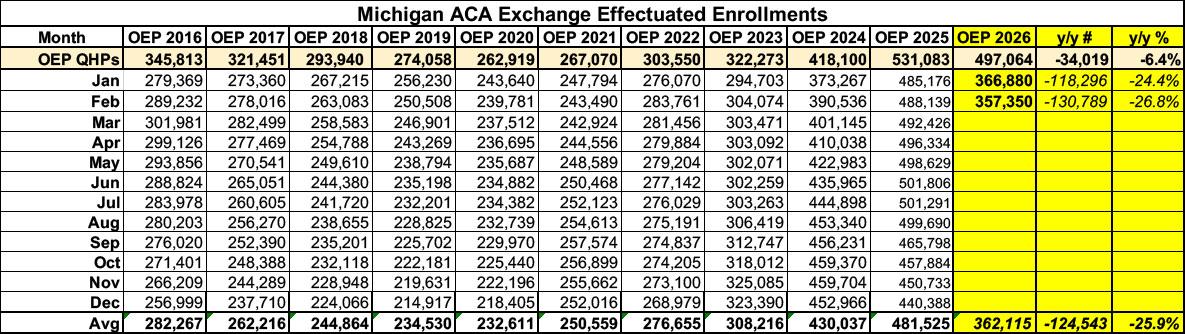
Before I begin, it's important to note that as in most states, ACA exchange enrollment has plummeted in Michigan since Congressional Republicans allowed the enhanced federal subsidies to expire at the end of last year: Effectuated enrollment was down 27% year over year as of February, and has almost certainly continued to drop further since then. That's at least 131,000 fewer Michiganders enrolled in ACA healthcare coverage this year.
Here's what this looks like visually, with both 2025 and 2019 (the last pre-COVID year, which didn't include the enhanced subsidies) included for comparison:
Long-time readers know that I've long been an advocate of more states breaking off of the federal ACA exchange (HealthCare.Gov) and establishing their own versions instead. While there are certainly benefits to utilizing the federal exchange (standardized interface, user experience, branding & marketing), there are also numerous benefits to states operating their own platforms.
In the early days of the ACA, in addition to the infamous technical meltdown of HealthCare.Gov, many of the state-based exchanges (SBEs) of the time included horror stories in which the 1.0 versions of SBEs either failed miserably, cost an insane amount and/or both. The most famous examples include...
I've written multiple times in the past about "Silver Loading," the ACA health insurance policy pricing strategy in which insurance carriers load the extra cost of their Cost Sharing Reduction financial burden (the portion of deductibles, co-pays & coinsurance which they're required to cover themselves for low-income enrollees who select Silver plans) onto the gross premium of those same Silver plans.
It gets a bit wonky, but the bottom line is that Silver Loading results in the gross price of Silver ACA plans increasing significantly even if the price of Bronze, Gold & Platinum plans only go up modestly. This may sound bad, but stay with me.
From the carriers perspective, how the CSR load is allocated doesn't matter much as long as they aren't left stuck with the bill...but pricing the plans in this fashion has major implications for the enrollees themselves.
On Monday I noted that around 20 state-based ACA exchange websites had launched 2026 Open Enrollment "window shopping," which allows residents to plug in their household information (zip code, ages, income, etc) and browse the various health insurance policies they have to choose from for coverage starting January 1st...as well as whatever federal (and state, in some cases) tax credits they'll be eligible for.
DIFS Encourages Michiganders to Plan for Health Insurance Coverage Now for 2026
(LANSING, MICH) The Michigan Department of Insurance and Financial Services (DIFS) is encouraging Michiganders to be ready for the upcoming Health Insurance Marketplace Open Enrollment period, which starts Nov. 1. A record 530,000 Michiganders are currently enrolled in health insurance through the Marketplace. Recent federal changes, as well as expiring tax credits, mean it has never been more important to review your insurance coverage and make a selection during the upcoming Open Enrollment period.
Every year, even when the ACA is running smoothly, there are always changes in market participation, as different insurance carriers enter or exit the individual market in certain states or either expand or shrink what parts of the state they offer healthcare policies in.
2026 is no exception, and given the massive turmoil the ACA exchanges are undergoing right now (due primarily to the expiring federal tax credits as well as regulatory changes made by the Trump Regime's so-called "Integrity & Affordability Rule"), there's either 13 or 32 insurance carriers throwing in the towel in one or more states, depending on how you count a carrier operating in multiple states or under multiple subsidiary brandings.
It's important to keep in mind that the following list probably isn't comprehensive--it includes the carriers which I've confirmed are pulling out statewide (with one exception: Meridian Health Plan of Michigan is only pulling out of parts of the state). There's likely one or two that I've missed, especially given that several of these have only made their final decisions within the past week or so.